Building Bright Futures in Greater Houston
RELEASED DECEMBER 1, 2025
FULL REPORT | ONLINE TOOL | DOWNLOAD DATA | BRAZORIA ONE-PAGER | FORT BEND ONE-PAGER

The years of emerging adulthood are a critical time for young people to develop skills, earn credentials, and enjoy a variety of experiences that together set them on a path to a fulfilling life. For some youth, though, this path is rocky; it is marked by spells of separation from school and work, institutions that are fundamental to the transition to adulthood. The presence of many disconnected youth, or opportunity youth and young adults (OYYA)—people between the ages of 16 and 24 who are neither working nor in school—in a community indicates limited resources and opportunities and results in high costs to society and individuals.
Building Bright Futures in Greater Houston focuses on a 13-county region that encompasses the same counties as the Gulf Coast Workforce Board – Workforce Solutions: Austin, Brazoria, Chambers, Colorado, Fort Bend, Galveston, Harris, Liberty, Matagorda, Montgomery, Walker, Waller, and Wharton. In Greater Houston, 13.3 percent of youth and young adults ages 16 to 24 are not in school and not working, which translates to roughly 124,500 young people cut off from crucial pathways to a fulfilling life. Of the top 25 most populous metropolitan areas in the United States, the Greater Houston area has the highest disconnection rate.
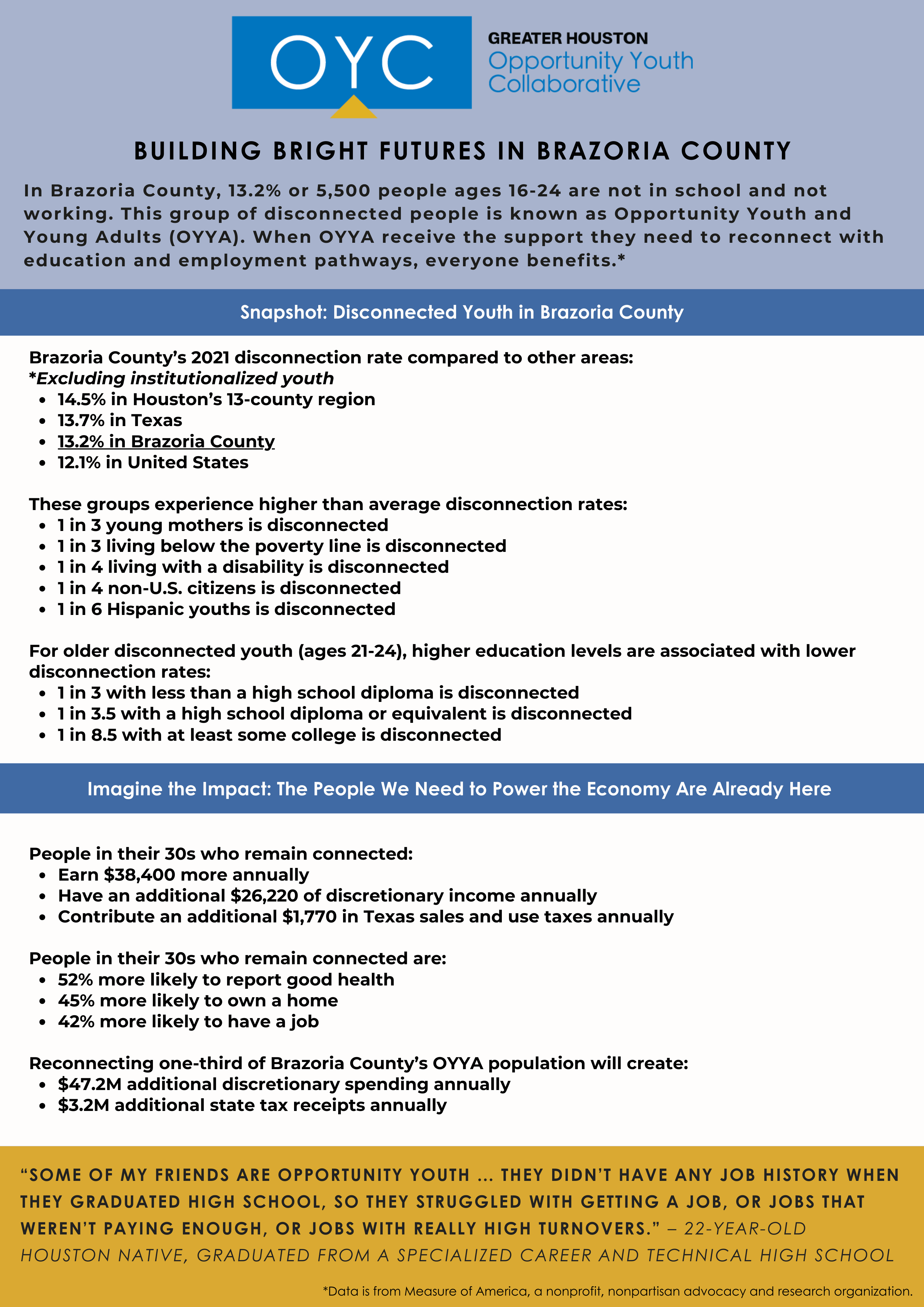
Houston stands to gain a great deal from addressing youth disconnection—first and foremost, increased opportunity, health, and well-being for more of its young people, a worthy end in itself. In addition, reducing the youth disconnection rate would dramatically boost the region’s economy. Measure of America research shows that young adults who worked or were in school throughout their teens and early 20s earn an average of $38,400 more per year by the time they reach their 30s than their peers who had been disconnected during emerging adulthood. The development of this report was guided by a panel of knowledgeable, passionate advisors deeply committed to Houston and who call the city home. This group worked together with the Measure of America team to identify a set of priority action areas, included in the report, necessary to ensure a future in which all Greater Houston’s residents can flourish.
KEY FINDINGS:
- If the disconnection rate in Houston was reduced by just one-third, to 8.9 percent, these 41,500 individuals, in their 30s, would have an additional $1.1 billion in discretionary income each year
- The disconnection rate among mothers in the 16- to 24-year-old age range, 41.7 percent, is much higher than that of young women without children, 10.8 percent
- One in four opportunity youth in Greater Houston are Hispanic girls or young women (33,000 across the 13 County Region)
- As of 2022, approximately 5,200 youth and young adults ages 16 to 24 in Houston are institutionalized in various facilities including prisons, detention centers, jails, group homes, residential treatment centers, and psychiatric hospitals
- The disconnection rate for noncitizens in Houston is 18.1 percent, compared to 12.6 percent for citizens
- An unusually high share of all young people in Greater Houston haven’t worked in the last five years: 35.8 percent of youth and young adults in Houston have never worked or last worked more than five years ago, compared to 32.4 percent in Texas and 26.6 percent in the United States as a whole
- In the 13 County Region, youth disconnection is not primarily an urban, suburban, or rural problem
- The highest youth disconnection rate, 23.6 percent, can be found in the East Aldine and Eastex-Jensen Area in northern Houston
- The lowest youth disconnection rate, 5.8 percent, is in the Washington/Memorial Park, Montrose, the Astrodome, and Braeswood area, which is also home to the University of Houston, Rice University, and the Texas Medical Center
OTHER TOPICS COVERED IN THE REPORT INCLUDE:
- Disconnection data by race/ethnicity and gender
- Data for Hispanic & Asian subgroups
- Immigration
- Institutionalized and systems-involved youth
- Return on investment for reconnecting young people
- Poverty
- Middle-skill jobs and labor force participation
- Motherhood & marriage
- Health insurance, food security, and substance use
- Workforce and technical education
- High school CTE, graduation, and absenteeism in Texas and Houston
- Household and family characteristics


For media and all other inquiries, contact us at: contact@measureofamerica.org