Measure of America: Humanizing Development in America
This blog post originally appeared in LA Counts on August 22, 2017. You can access the original article here.
By: Marina Recio, Program Assistant, Measure of America
Los Angeles County is blessed with a diverse population, a dynamic economy, a beautiful coastline, and a dedicated community of organizations and individuals invested in making it a better place. The county, like many other US counties, also faces some serious challenges in terms of supporting residents to live fulfilling, productive lives.
So how is Los Angeles County doing, and how does it stack up against other communities? That’s a question that communities across the United States often ask themselves, and the yardstick we use to answer it depends on what we value.
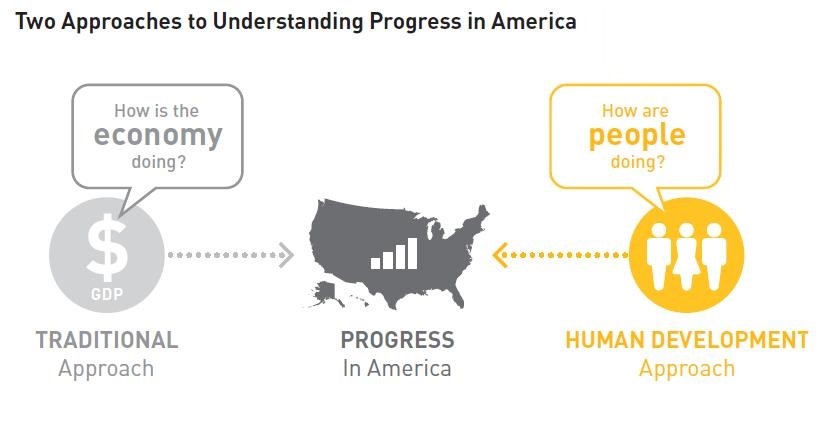
Traditional measurements of development often tell us how the economy is doing. California’s Gross Domestic Product (GDP) per person of $59,000 is virtually the same as that of Wyoming. But there is no doubt that the assets and challenges of each state are unique and by this measure, we fall short of capturing how people are doing. A more holistic approach for measuring people’s well-being brings us closer to finding a better answer.
Rethinking Development: The HD Index is Born
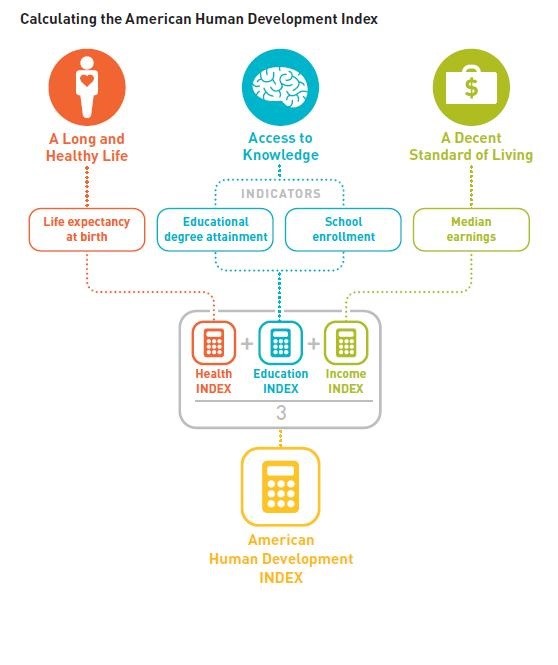
In 1990, a ground-breaking report from the United Nations fundamentally shifted how the world understood development. “People are the real wealth of a nation,” the seminal Human Development Report opened. “The basic objective of development is to create an enabling environment for people to enjoy long, healthy and creative lives.” The influential report introduced a human-centered approach to development and a new tool for measuring progress, the Human Development Index (HDI), a composite index reflecting three essential ingredients of well-being and opportunity: a long and healthy life, access to knowledge, and a decent standard of living. Development around the world would no longer be measured exclusively by GDP per capita, but by what an ordinary person could do or be.
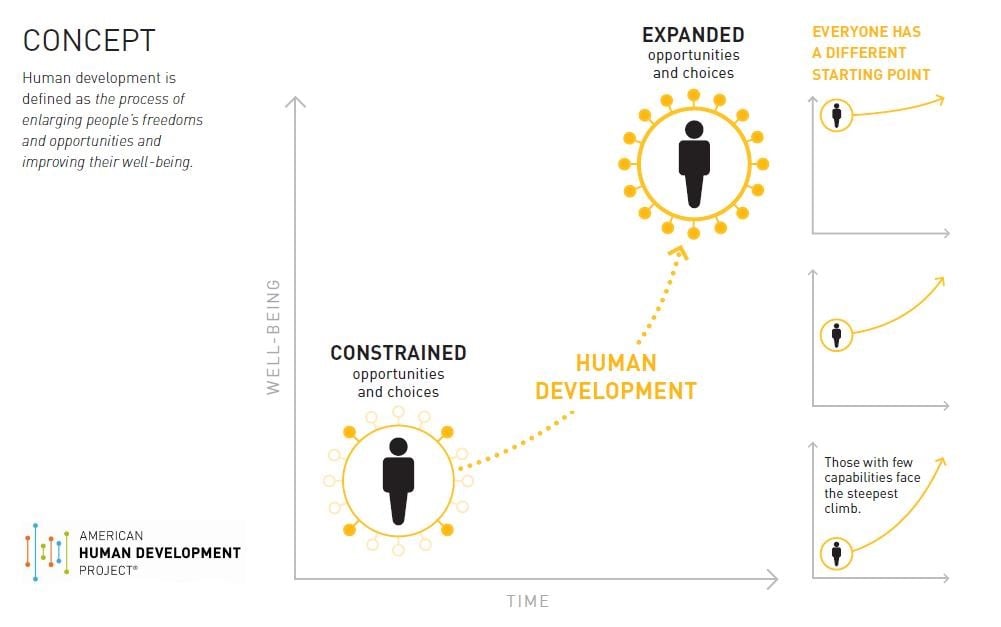
Human development, the brainchild of Pakistani economist Mahbub ul Haq, is defined as the process of enlarging people’s freedoms and opportunities and improving their well-being. At the World Bank in the 1970s, and later as minister of finance in his own country, Pakistan, Dr. Haq argued that existing measures of human progress—GDP in particular—failed to account for the true purpose of development: to improve people’s lives. Dr. Haq often cited the example of Vietnam and Pakistan; both countries had the same GDP per capita—around $2,000 per year—but Vietnamese were living eight years longer than Pakistanis and were twice as likely to be literate. Together with Nobel Laureate Amartya Sen and other gifted economists, Dr. Haq published the first U.N. Human Development Report, which ranked countries using the HDI. Every year since, the United Nations Development Programme office has published a Human Development Report.
The world quickly adopted the HD Index as the gold standard for quantifying development. Many countries made the HD Index an official measurement of well-being; others began publishing their own annual national human development reports. One notable exception was the United States. In the wealthiest nation on Earth, the concept of “development” had been typically regarded as exclusive to developingcountries, irrelevant to our developed nation, and progress in the United States had been defined largely in purely economic terms, with GDP per capita as one of the most common yardsticks. This, however, would soon begin to change.
From GDP to American HD Index: A New Approach for the United States
In 2008, important conversations about inequality and access to healthcare were surfacing to the mainstream; in the midst of the financial crisis, there was growing demand for a new way of understanding progress beyond GDP. Two former career U.N. professionals, equipped with years of experience working on development issues, saw an opportunity to introduce the human development approach to the United States. Nearly two decades after the U.N. released its first Human Development Report, Sarah Burd-Sharps and Kristen Lewis published the first national human development report for the United States.
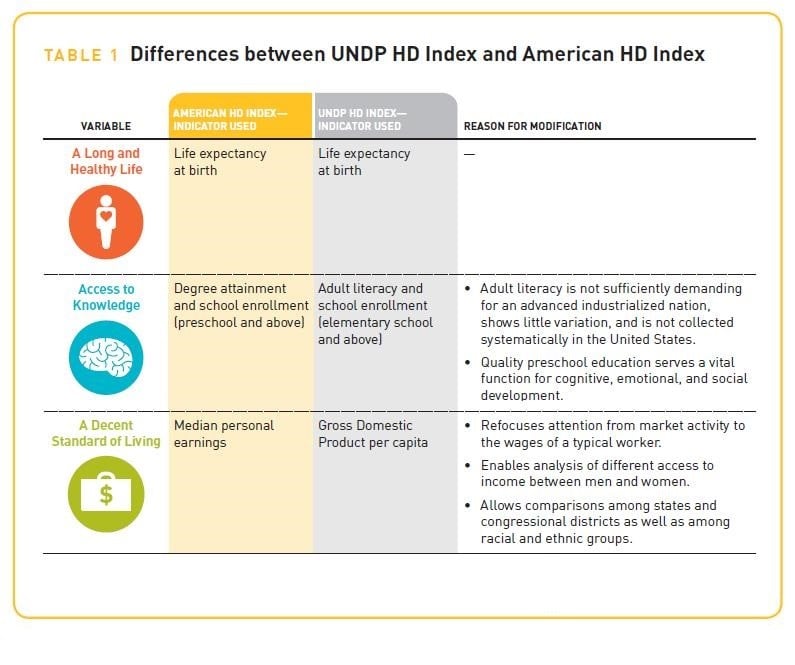
The Measure of America: American Human Development Report, 2008-2009, the first of its kind, introduced the American Human Development Index (AHDI), an adaptation of the HD Index for the United States. The American HD Index measures the same three fundamental areas of well-being—a long and healthy life, access to knowledge, and a decent standard of living—using indicators more appropriate for an affluent, developed nation (see Table 1 for more details on modifications). Burd-Sharps and Lewis have since published three more national human development reports for the United States and several more for individual states and counties—including California, Marin County, and Sonoma County.
Looking Ahead: A Steady Shift Towards Well-Being
In 2008, former French President Sarkozy convened a commission to outline the limits of GDP and to explore alternative measurements for social progress. Their report gave momentum to the “Beyond GDP” movement and It is now conventional wisdom that GDP does not tell the full story, and that measuring things like the health, education, and the standard of living of ordinary people are just as important as market growth. Now more than ever, the human development approach and the AHDI can be powerful tools to assess how Americans are doing and design policies aimed at improving ordinary people’s lives.
Today, Measure of America, a project of the Social Science Research Council headed by Burd-Sharps and Lewis, creates easy-to-use yet methodologically-sound tools for understanding the distribution of opportunity in America, using the human development approach as its conceptual framework. The project produces an annual national human development report and similar reports for states, counties, and cities featuring its hallmark American HD Index for different populations, as well as thematic reports on particular well-being issues like youth disconnection and discriminatory lending, and interactive websites like DATA2GO.NYC. Our work has already succeeded in making well-being data easily-accessible for communities, informing policy, and influencing philanthropic decision-making. With funding from a consortium of Los Angeles-based philanthropic partners and the Los Angeles County Productivity Investment Fund of the Quality and Productivity Commission, Measure of America is hard at work on A Portrait of Los Angeles County. The report, slated to launch in November 2017, will examine the distribution of well-being and opportunity in the county, putting Los Angeles residents at the center of measuring progress and well-being for cities, unincorporated areas, City of LA Community Plan areas and Council Districts, for racial and ethnic groups, women and men, native- and foreign-born, and other groups. To learn more about the human development approach and find out how your community stacks up, visit our website at: www.measureofamerica.org.
Oct. 4: Health, Wealth, and Housing: Promoting Cross-Sector Collaborations for Equity Conference
October 4, 2017 — Los Angeles, CA. Measure of America co-director Sarah Burd-Sharps will participate in the Health, Wealth, and Housing: Promoting Cross-Sector Collaborations for Equity Conference hosted by the Federal Reserve Bank of San Francisco. Sarah will discuss the latest research and evidence-based strategies that move the needle on improving the quality of life for low-income families with other expert panelists.
W.Va. hopes tech-voc education will remedy skills gap, opioid crisis
August 14, 2017 — HR Dive
Seeing Hope for Flagging Economy, West Virginia Revamps Vocational Track
August 10, 2017 — The New York Times
Health disparity across Petaluma
August 7, 2017 — Petaluma Argus Courier
Forging Connection for Disconnected Youth
July 31, 2017 — Local Initiatives Support Corporation blog
Aug. 4: Philanthropy’s Impact in the Southwest: Strengthening Local Communities to Achieve Global Goals
August 4, 2017 — Albuquerque, NM. Measure of America’s co-director Kristen Lewis will be a speaker in a meeting about the role of philanthropy work in the Southwest in contributing to the universal Sustainable Development Goals (SDGs) co-hosted by the Council on Foundations, Philanthropy Southwest, and Albuquerque Community Foundation. For more information, click here.
Why Data Matters: A User’s Perspective
This blog post originally appeared in SSRC’s Parameters on July 26, 2017. You can access the original article here.
This piece is part of Parameters’ Data Stories series, and reads well in conversation with Ken Prewitt’s explanation of the Census crisis.
By Alex Powers and Marina Recio
To say that it has been a bad year for government data is an understatement. With the 2020 decennial census around the corner, the Census Bureau finds itself underfunded and without a leader after its director stepped down earlier this year. The decennial census is the most consequential survey exercise in the country; from determining how billions of federal dollars are distributed to dictating congressional representation, the impact of the census cannot be overstated. As the Census Bureau nears a crisis, it is more important than ever to remember why high-quality government data matter for Americans.
Inveterate innovator Benjamin Franklin once quipped, “An investment in knowledge always pays the best interest.” That adage holds true today—without doing the work to learn about the world, there is little we can do to change it. The need for actionable data is important enough to be enshrined in our Constitution, within the provision that established the United States Census. Unlike censuses in other countries, which were meant to tax or conscript, the United States Census was the first one designed to empower; it was—and still is—the basis of representation in Congress and ultimately government spending.
Publicly available data are tremendously valuable and empowering. To give an example close to home, without these data, our organization, Measure of America—a project of the Social Science Research Council— would not have the raw materials necessary for our calculations of life expectancy at birth, youth disconnection, and many other vital measures of the lives of ordinary Americans.
These calculations, in turn, provide the public health workforce, community organizations, youth training programs, and philanthropies with important statistics to inform their work. We learned, for example, that California’s Latinos, on average, outlive whites in the state by 3.6 years. In the Baltimore metro area, Asian Americans outlive African Americans in the same city by an average of 17 years (90.5 years vs. 73.4 years). We learned that, though fewer young people are disconnected from school and work today than were before the peak of the Great Recession, about one in four young people ages 16 to 24 who are Native American or live in the rural South are still disconnected.
The hallmark of our work, and a product of openly available data, is a measure of well-being and access to opportunity in American communities called the American Human Development Index. It is based on the time-tested index used by the United Nations each year to measure development in every country. This index connects three basic areas of life—health, education, and standard of living—on one scale, allowing well-being comparisons between places and groups.
For health, our American Human Development Index requires life expectancy at birth, a basic summary measure of survival. Using mortality and population data from an agreement with the National Center for Health Statistics of the Centers for Disease Control and Prevention, we have calculated life expectancy at birth for every US state, congressional district, major metro area, and for the major racial and ethnic groups in each of these geographies.
These data have been cited in theLancet, the American Journal of Public Health, and over forty other journal articles as well as twenty-six books since we began in 2008. They are the benchmark used by the Organization for Economic Cooperation and Development for international comparisons and have been used by state and local health departments across the country. Illinois has used them to study their aging population, New Orleans to map domestic violence, amongst many others. In short, there is tremendous demand for these data as a basis for research, policy, advocacy, and local actions to build healthier communities. And without the costly investment of public agencies in data collection, these next steps would not be possible.
As we discuss what we should invest in as a nation, let’s keep in mind that government data is not a luxury; it is a public good and a necessity. Our jobs, and those of many other researchers (from hedge fund analysts and geologists to historians and cancer geneticists), are dependent on the government to collect and make data available that no other organization has the capacity to produce. Without it, we would know much less about the world we live in—and what we can do to improve it.
Hospital detachment eliminates river area advocacy job
July 25, 2017 — Sonoma West Times & News
Cottage Health Debuts Free Population Health Data Tools
July 22, 2017 — Noozhawk
